
How the Himalayasgave South Asiansdiabetes.
A continental collision raised a wall. The wall created a monsoon. The monsoon created a breadbasket, and the famines that followed shaped the bodies that walk into endocrinology clinics today. The story of how geology became biology.
If you want to understand why roughly one in four South Asian adults in the United States lives with type 2 diabetes (a rate four to six times that of white Europeans in the UK by some estimates), you have to start about fifty million years ago, with two slabs of continental crust grinding into each other at the speed a fingernail grows.
That collision created the Himalayas. The Himalayas, in turn, created the Indian monsoon. The monsoon created an agricultural civilization of staggering density. And that civilization, through a relentless cycle of fertility and famine sustained over millennia, appears to have shaped the bodies that walk into endocrinology clinics today.
This is the story of how geology became biology.
India, on the move
India breaks from Gondwana 140 million years ago and ploughs north into Asia at roughly the speed a fingernail grows — eventually crumpling the crust into the Himalayas.
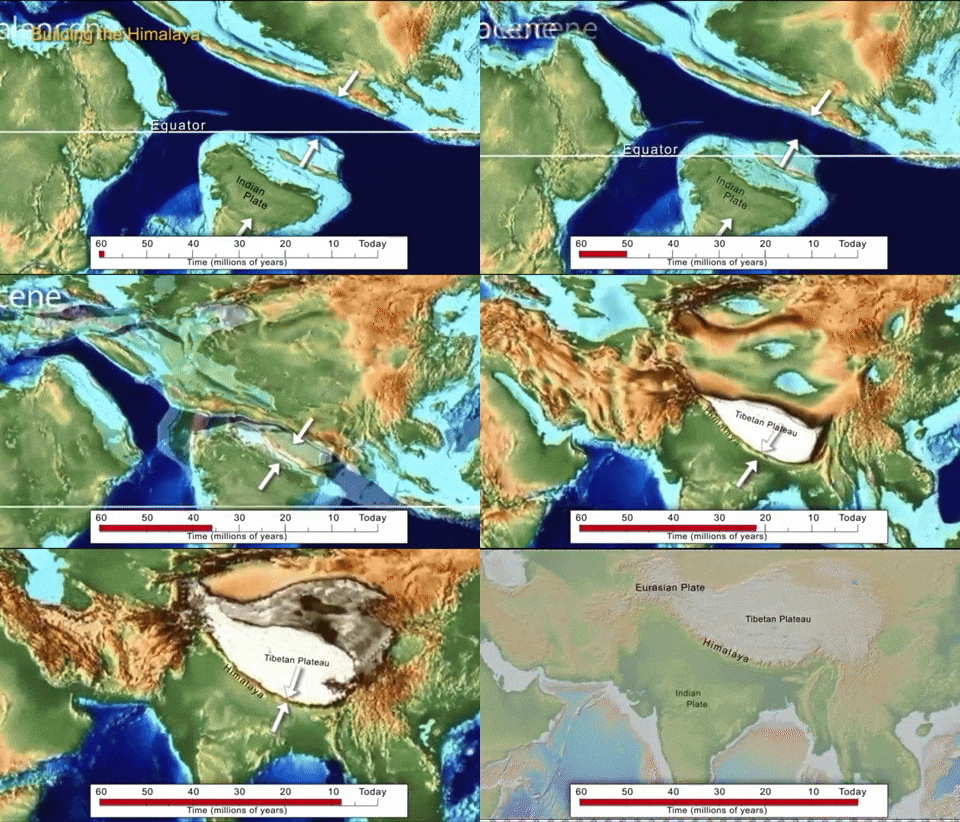
Source: USGS · Building the Himalaya
A continent that didn’t stop moving
For most of the planet’s history, the landmass we now call India was not part of Asia. It was a fragment of the southern supercontinent Gondwana, attached to Africa and Antarctica. Around 140 million years ago, it broke loose and began drifting north, fast by tectonic standards. At its peak speed, the Indian plate moved at about 15 to 20 centimeters per year, a rate that geophysicists still find puzzling.
It eventually caught up with Eurasia. The leading edge of the collision is dated to somewhere between 55 and 40 million years ago, though recent constraints point to an onset around the middle Paleocene, roughly 59 million years ago. Because both plates were continental (buoyant, similar in density), neither could slide cleanly under the other. The crust crumpled. The sediments and metamorphic rock of the Indian margin were thrust upward against the Tibetan landmass, and what had been a seabed (the ancient Tethys Ocean) became the roof of the world.
That collision has never really stopped. India continues to push north into Asia, and the Himalayas continue to rise, by roughly two centimeters a year, even now. This is the longest continuous mountain-building event in the geological record of the last hundred million years, and it is the engine of nearly everything that follows in this story.
The weather machine
A mountain range that high does more than block traffic between civilizations. It rearranges the atmosphere.
The Tibetan Plateau, pushed up alongside the Himalayas, rose above about 3.5 kilometers between roughly 27 and 38 million years ago. As it climbed, it began acting like a vast solar panel: in summer, the plateau heats much faster than the surrounding oceans, generating a low-pressure zone that draws moist air northward off the Indian Ocean. That moisture-laden air hits the wall of the Himalayas, is forced upward, cools, and dumps its water as rain.
The result, codified across the geological record by about 8 million years ago, is the Asian monsoon, the largest weather system on Earth. It is also one of the most consequential. The southwest monsoon delivers the bulk of India’s annual rainfall between June and September, replenishes the great rivers of the subcontinent (the Indus, the Ganges, the Brahmaputra), and floods the alluvial plains with the silt that makes them so absurdly productive.
The wall and what it made
The Himalayas divide two worlds: the lush, river-threaded Indo-Gangetic plain to the south and the arid Tibetan plateau to the north. Without this wall, the monsoon (and everything it fed) would not exist.
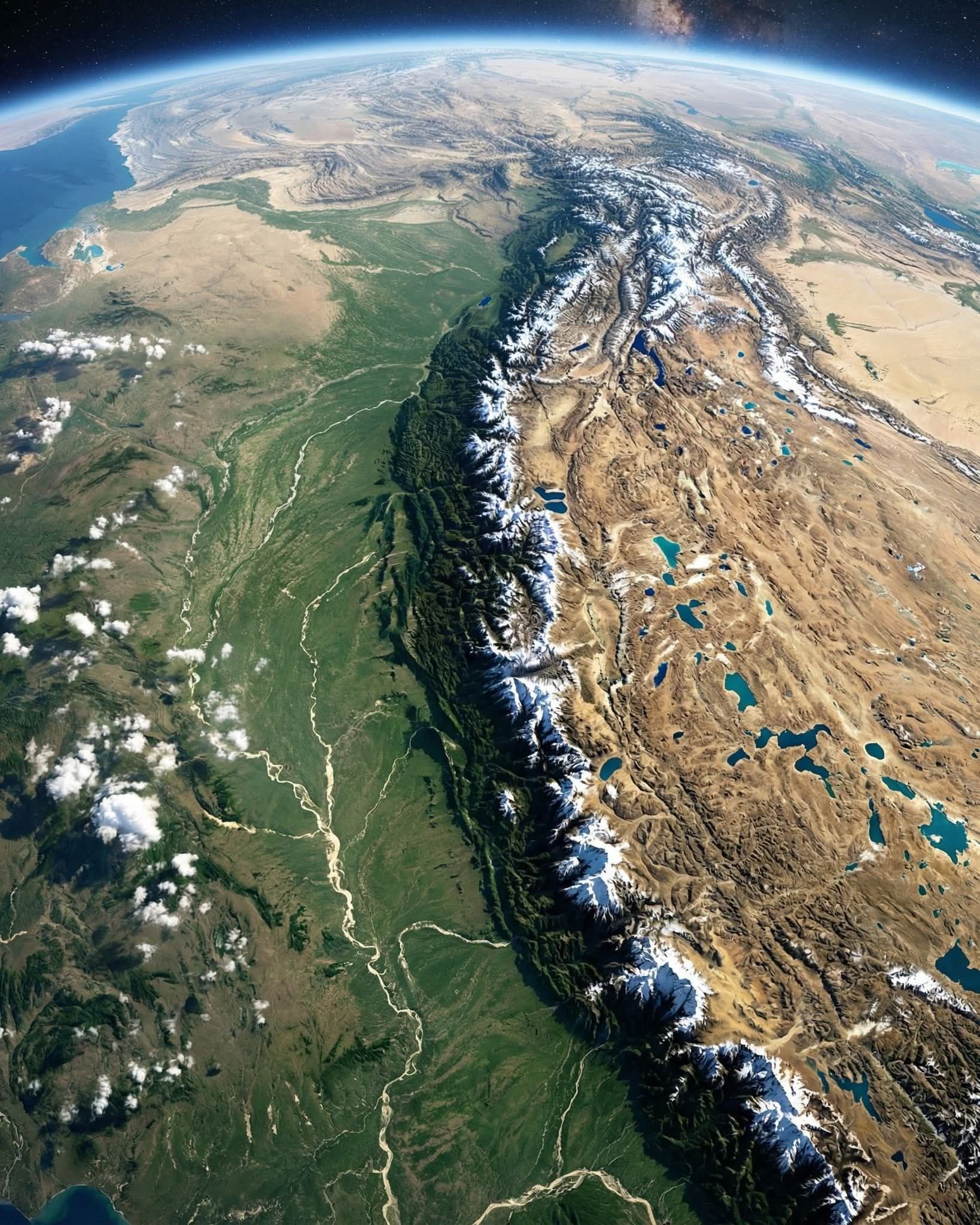
The Himalayas seen from orbit · Indo-Gangetic plain (left) · Tibetan plateau (right)
A cradle of farming, a cradle of crowding
Humans arrived in the Indian subcontinent early. Genetic and archaeological evidence converges on a southern coastal migration out of Africa that brought modern humans into South Asia by roughly 65,000 to 75,000 years ago, among the earliest human presences outside Africa.
Farming arrived much later. The oldest known agricultural settlement in South Asia is Mehrgarh, in modern-day Balochistan, Pakistan. Recent radiocarbon work using tooth enamel rather than charcoal has revised Mehrgarh’s age downward from the long-quoted 8,000 BCE to roughly 5,200 BCE, still ancient but now closer in time to the spread of Near-Eastern farming techniques than to an independent origin. The earliest Mehrgarh farmers cultivated barley and wheat, herded sheep, goats, and zebu cattle, and laid the groundwork for what would become the Indus Valley Civilization a few millennia later.
From there, farming spread across the subcontinent on a substrate practically engineered for it: monsoon-fed rivers, silt-rich floodplains, a long growing season. The carrying capacity was enormous. Over the centuries, the Indo-Gangetic plain became, and remains, one of the most densely populated regions in human history. By the modern era, South Asia hosts roughly a quarter of humanity on about three percent of the planet’s land area.
This is the part that matters for diabetes: a very large population, packed into a very productive landscape, dependent on a single weather system that is, to put it mildly, moody.
A quarter of humanity, three percent of the land
The Indo-Gangetic plain, visible as the blazing orange band running east across northern India, is one of the most densely settled corridors on Earth, a direct consequence of the monsoon-fed rivers and silt-rich floodplains the Himalayas created.
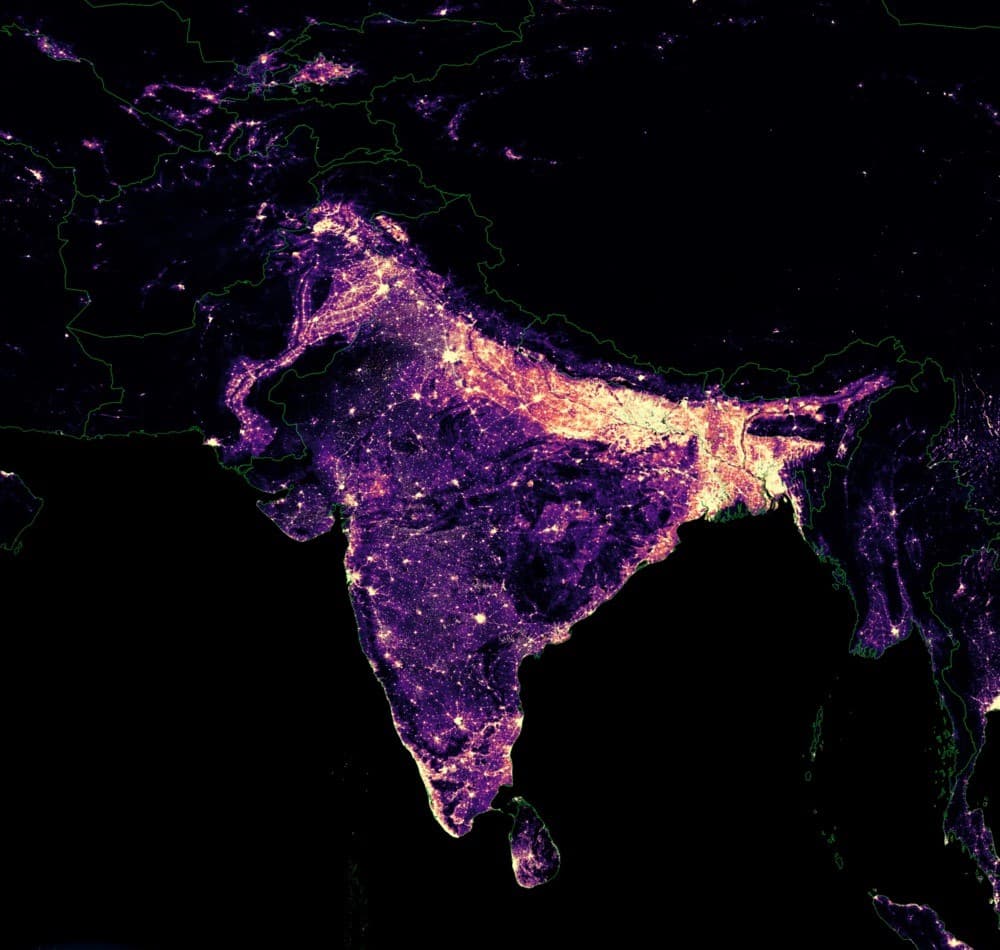
The other face of the monsoon
The monsoon giveth. The monsoon also taketh away.
Some years it delivers too much: catastrophic flooding that drowns standing crops, destroys grain stores, and washes away the topsoil that future harvests depend on. Some years it delivers too little, or too late: the rains fail, rivers run thin, and the calorie supply for tens of millions of people collapses on a season’s notice. Because the population density rests on the agricultural surplus, and the surplus rests on the rains, a bad monsoon does not just mean inconvenience. It means famine.
The historical record is grim. Between 1770 and 1900 alone, an estimated 25 million Indians died in famines: a death toll, over that span, several times larger than all wartime deaths worldwide in the same period. The Great Bengal Famine of 1770 may have killed up to 10 million people, roughly a third of the affected region’s population. The Bengal Famine of 1943, the last major famine on the subcontinent, killed somewhere between 0.8 and 3.8 million people, with scholarly consensus near 2.1 million. The economist Amartya Sen, who lived through it as a child, would later argue that this was not principally a failure of food production but of entitlement. The bodies were no less dead for the analytic distinction.
These are only the famines large enough to enter the colonial record under that name. Smaller, regional crop failures recurred constantly.
The other face of the monsoon
When the monsoon failed, the consequences were not inconvenient. They were catastrophic. Between 1770 and 1900 alone, an estimated 25 million Indians died in famines. This photograph, taken during the Great Famine of 1876–78, shows victims in southern India. The scale of mortality is the selection pressure.
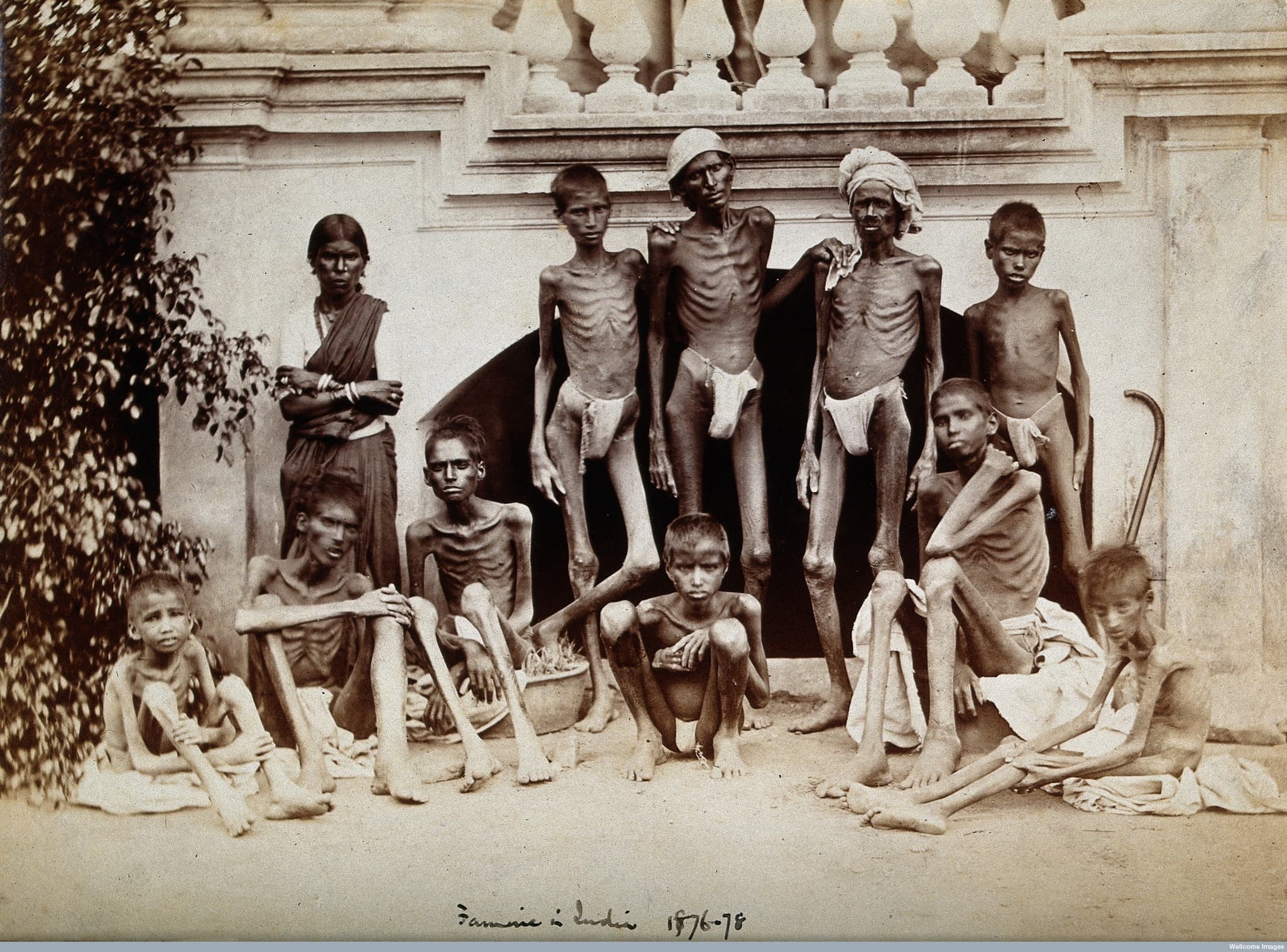
Famine victims, southern India, 1876–78 · W. W. Hooper · Wellcome Library
Selection pressure, written into bodies
Anything that kills millions of people, repeatedly, over thousands of years, is, in the cold language of population biology, a selection pressure. It does not need to be uniformly lethal to leave an evolutionary mark. It only needs to be non-random with respect to traits.
Famine selects strongly for thrift. Bodies that store calories efficiently when food is available, mobilize them slowly when food is scarce, and shunt scarce nutrients toward survival rather than growth or reproduction are bodies that more often live to reproduce. Over many generations, in a population repeatedly hammered by famine, the genetic and developmental architecture of thrift gets enriched.
This is the substance of two related ideas in evolutionary medicine. The first, proposed by the geneticist James Neel in 1962, is the “thrifty genotype” hypothesis: the suggestion that certain populations carry inherited variants tuned for feast-and-famine cycles: adaptive when calories are unreliable, pathological when calories are abundant. The second, introduced by Hales and Barker in 1992, is the “thrifty phenotype” hypothesis: the idea that undernourished fetuses make developmental choices in the womb that prioritize survival of the brain and other essential tissues at the expense of organs like the pancreas, with consequences that compound across the lifespan and can be transmitted from mother to child.
Both hypotheses remain debated in their details. The “thrifty gene” story, in particular, has been criticized for being difficult to test and for not always fitting the genetic evidence. But the broader framework, that recurrent nutritional stress shapes human biology in ways that backfire in modern nutritional environments, is widely taken seriously, especially in the South Asian context.
The thin-fat body
You can see what thrift looks like, in part, by looking at South Asian bodies.
Compared to white Europeans of the same body mass index, South Asian adults tend to carry more visceral fat, the metabolically active fat that wraps the organs, rather than the more benign fat that sits under the skin. They tend to have lower lean muscle mass. They tend to deposit fat ectopically, in the liver and in skeletal muscle, where it interferes with insulin signaling. They tend to be more insulin-resistant at any given weight.
Clinicians call this the “thin-fat” phenotype, and it is observable from birth. Babies born to Indian mothers, on average, are lighter than European babies, but they carry a higher proportion of body fat, particularly truncal fat. If those babies then experience accelerated postnatal growth, especially in a calorie-rich environment, they become significantly more insulin-resistant in childhood and adolescence than their European counterparts.
It is worth being careful about which differences are real and which are folk-wisdom. The popular claim that South Asians have a markedly lower resting metabolic rate than Europeans (sometimes quoted as a 25 to 30 percent gap) is not well supported by the controlled studies that have looked specifically at resting energy expenditure. The more robust differences appear to be in metabolic flexibility (the body’s ability to switch between burning carbohydrates and fats), in the magnitude of the insulin-sensitivity hit taken from modest weight gain (a 38 percent decrease in South Asians versus 7 percent in white Europeans in one recent controlled study), and in where and how fat is stored.
The picture, then, is not that South Asians “burn fewer calories.” It is that South Asians’ bodies handle calorie surplus in a way that is exquisitely poorly matched to a modern environment. A small surplus, sustained over time, produces a large and disproportionate metabolic penalty.
The mismatch
Type 2 diabetes is, at its core, a disease of mismatch. The body’s machinery for storing and mobilizing energy was shaped by environments in which calories were inconsistent, often scarce, and physical activity was non-negotiable. Modern environments invert all three variables: calories are constant, often abundant, and physical activity is something you have to deliberately schedule.
In populations whose evolutionary history has tuned them toward thrift, the mismatch is more violent. South Asians develop type 2 diabetes at lower body mass indices than Europeans, at younger ages, and with a faster decline in pancreatic β-cell function once the disease takes hold.
The prevalence gap
Type 2 diabetes prevalence across populations. Tap any bar to see the ratio against the white-American reference.
- White Europeans (UK)5.5%
- White Americans7.4%
- Global average10.5%
- South Asians (global)12.7%
- South Asian Americans26%
- Pakistan30%
~3.5× the white-American rate. Diaspora data, MASALA + MESA studies.
A strange beauty
There is a strange beauty, of a kind, in the chain of causation. A continental collision tens of millions of years ago raised a wall. The wall created a weather system. The weather system created a breadbasket. The breadbasket supported a vast population. The population was periodically and catastrophically starved. The survivors passed down bodies a little better at hoarding calories. And then, in a historical eye-blink, those bodies found themselves in a world of office chairs and refined carbohydrates.
The Himalayas did not cause diabetes, in any direct sense. But they laid the conditions (geological, climatic, agricultural, demographic) under which evolution would write the biology of an entire region’s bodies. The mountains are still rising. So, in clinics from Karachi to California, are the diagnoses.

Founder & Head Coach @Shaksthetics. Natural bodybuilder. South Asian American who has had this conversation with too many family members.
Sources
- The HimalayasUSGS, This Dynamic Earth
- Evolution of Asian monsoons & uplift of the Himalaya–Tibetan plateauNature
- Indus Valley farming started later than thoughtNature
- MehrgarhWikipedia
- Famine in IndiaWikipedia
- Bengal famine of 1943Wikipedia
- Thrifty gene hypothesisWikipedia
- Diabetes in South Asians: Is the Phenotype Different?Diabetes (ADA)
- Body Composition and Diabetes Risk in South Asians: MASALA + MESAPMC
- Thin Fat Obesity: The Tropical Phenotype of ObesityEndotext, NCBI
- Weight gain leads to greater adverse metabolic responses (GlasVEGAS)Nature Metabolism
- Lessons Learned From Epidemiology of T2D in South AsiansDiabetes Care (ADA)
- Population density map of South Asia© Robert Szucs / Grasshopper Geography
- WW Hooper: Group of Emaciated Young Men, India Famine 1876–78Wellcome Library Image Catalogue